A Guide to Mattress Deep Cleaning for Hotels and Suites
Why mattress deep cleaning matters for hospitality businesses like hotels and suites.
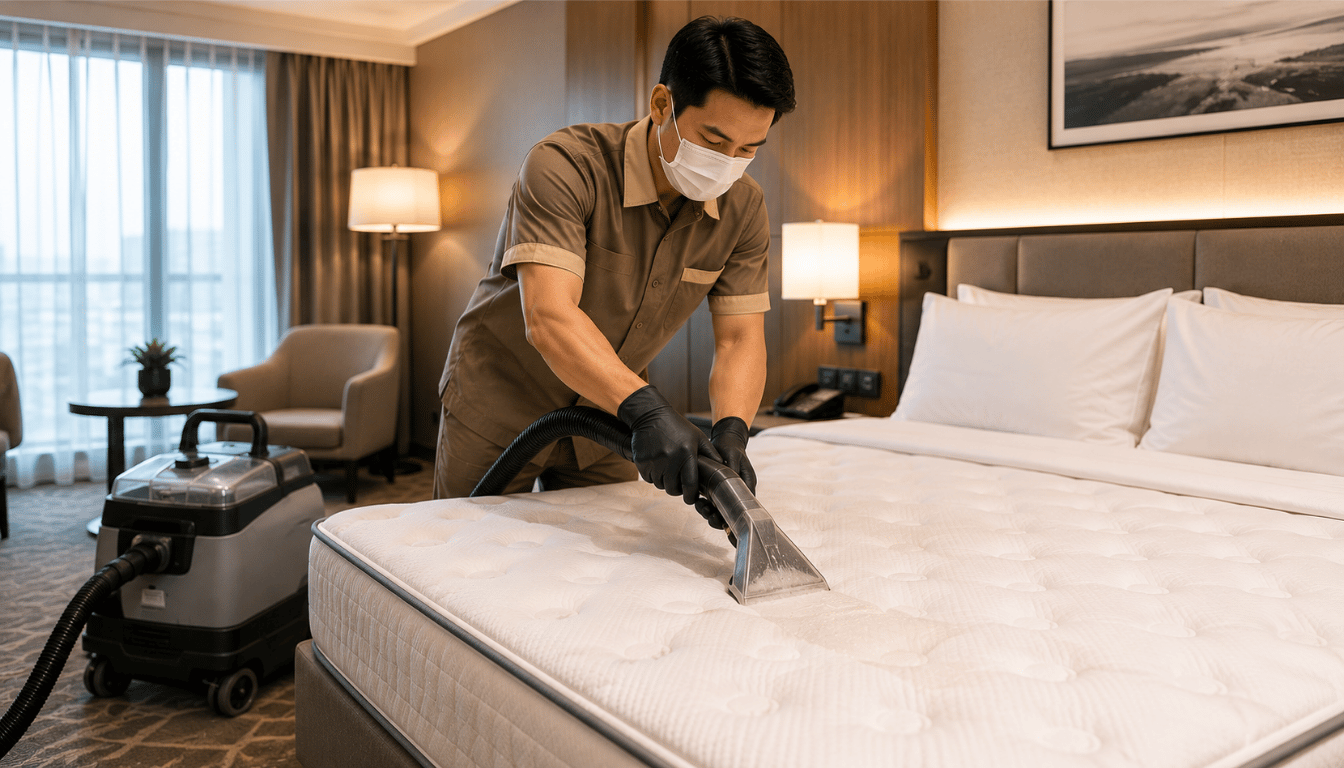
Mattress deep cleaning is needed periodically because a mattress absorbs sweat, dead skin cells, and moisture every night, which over time becomes a breeding ground for dust mites and a source of odor that a linen change alone won't fix. For hospitality businesses like hotels and suites, mattress condition also directly affects the hygiene standard guests experience with every stay — often long before any complaint is ever raised out loud.
1. Why Mattresses Need Deep Cleaning, Not Just a Linen Change
A mattress absorbs moisture from sweat every night, and even with regular sheet changes, the surface layer beneath stays exposed to that moisture over the long term. The combination of moisture, dead skin cells, and body heat creates an ideal environment for dust mites to multiply within the mattress fibers, particularly in mattresses that have been used for years without deep treatment [Insert reference to a health study/source on dust mites and sleep quality]. This buildup happens gradually enough that it's rarely noticed until a guest or staff member raises a specific complaint.
Surface vacuuming or changing sheets does help keep a mattress looking tidy, but it doesn't reach dirt that's already worked into the inner layers. That's why mattress deep cleaning is a necessary extra step, particularly for high-usage properties like hotels and suites with fast guest turnover.
Unlike carpet or upholstery, which tolerate moisture more readily, a mattress has an inner foam or spring layer that requires more careful handling to avoid becoming overly wet during cleaning. Excess moisture that isn't fully dried can create a new problem — a musty smell or mold growth inside the mattress, which is often harder to remediate than the original dirt the cleaning was meant to address.
2. How a Neglected Mattress Affects a Hospitality Business
For a hospitality business, mattress condition isn't just about visual cleanliness — it directly connects to guest experience and satisfaction. The bedroom is the space guests spend the most direct physical contact with during a stay, so mattress condition indirectly shapes how they judge the entire experience, often more than any other single element of the room:
- Allergy and respiratory complaints — guests sensitive to allergens may experience sneezing, congestion, or skin irritation from dust-mite exposure on a rarely-treated mattress.
- Odor that lingers even after a linen change — a musty or damp smell coming from within the mattress doesn't disappear just by swapping the linens, and can affect a guest's comfort from the moment they enter the room, sometimes shaping their impression before they've even unpacked.
- Stains that are hard to explain to a new guest — old stains left untreated can soak in deeper and become harder to remove, dragging down the overall impression of a room's cleanliness.
- Impact on reviews and reputation — an uncomfortable or odorous mattress can become one of the most common complaints in guest reviews, even when the rest of the room's cleanliness is otherwise solid, and such reviews are often the hardest kind to walk back.
Different Needs Based on Guest Turnover
Each type of accommodation has slightly different mattress deep-cleaning needs depending on guest turnover. Hotels and suites with high turnover, such as accommodations in the Olé Suites segment, generally need more frequent cleaning due to guests changing over every few days. Longer-stay accommodations, on the other hand, can schedule deep cleaning at a different interval matched to the average length of stay.
3. How TUM Clean Handles Mattress Deep Cleaning in Bogor
Method and Process Stages
TUM Clean, operated under the legal entity PT. Tunggal Utama Makmur and based in Sentul, Kecamatan Babakan Madang, Kabupaten Bogor, handles mattress deep cleaning for hospitality clients across Bogor, Sentul, Ciawi, Cibinong, Cibubur, and Depok. The process generally covers:
- High-pressure vacuuming using specialized equipment to lift dust and dry particles from the surface down to the mattress's upper layer before the wet process begins.
- Stain pre-treatment using a solution matched to the stain type and mattress material, left to sit briefly before extraction.
- Sanitizing process using a method that helps reduce the dust mite and allergen population within the mattress fibers, without leaving the mattress excessively wet.
- Thorough drying before the mattress is covered with linen again, to make sure no residual moisture is left that could trigger mold growth.
Deep-cleaning schedules are matched to each room's turnover rate — high-occupancy rooms are generally scheduled more often than rarely-used rooms, with the exact cadence often adjusted after the first service cycle based on real usage patterns.
Common Mistakes in Mattress Care at Hospitality Facilities
Some frequent mistakes found in facilities without a structured mattress deep-cleaning schedule include:
- Relying only on a linen change with no treatment of the mattress itself, so dirt and allergens in the inner layers keep building up over time.
- Treating stains too slowly, allowing them to soak in deeper and become harder to remove without damaging the mattress layer.
- Not differentiating the schedule by usage level, so a high-turnover room gets the same treatment as a rarely-used one, wasting service capacity that could go to units that actually need it more.
- Not fully drying the mattress before re-covering it with linen, which risks trapping hidden moisture and triggering odor or mold growth later on.
4. Building a Mattress Deep-Cleaning Schedule Matched to Your Business
The right deep-cleaning schedule should factor in several elements below, rather than applying one uniform schedule across every room:
- Guest turnover rate for each room or unit.
- A history of allergy, odor, or stain complaints tied to a specific mattress.
- Mattress type and age, since older mattresses generally need more frequent treatment than newer ones.
- Peak booking seasons, since periods of higher occupancy typically speed up dirt buildup on mattresses.
As a general illustration, high-turnover hotel or suite rooms may need mattress deep cleaning every few months, while rooms with lower occupancy can be scheduled less often [Insert specific frequency recommendation based on a site survey]. This approach also helps a housekeeping team prioritize which units need treatment first when service capacity is limited. Scheduling based on these factors also helps a hospitality business avoid emergency-level costs, such as replacing a mattress early because a stain or odor has become too severe for regular cleaning to address. To get a mattress deep-cleaning schedule matched to your business, please Contact Us, or read Articles on specialist and project cleaning.
FAQ
Quick and Practical Consultation
Address
Darmawan Park, Jl. Babakan Madang No.99, Sentul, Kec. Babakan Madang, Kabupaten Bogor, Jawa Barat 16810
Google Maps