Microfiber Color-Coding Guide to Prevent Cross-Contamination
Learn how a microfiber color-coding system works and how to apply it to prevent cross-contamination across your business
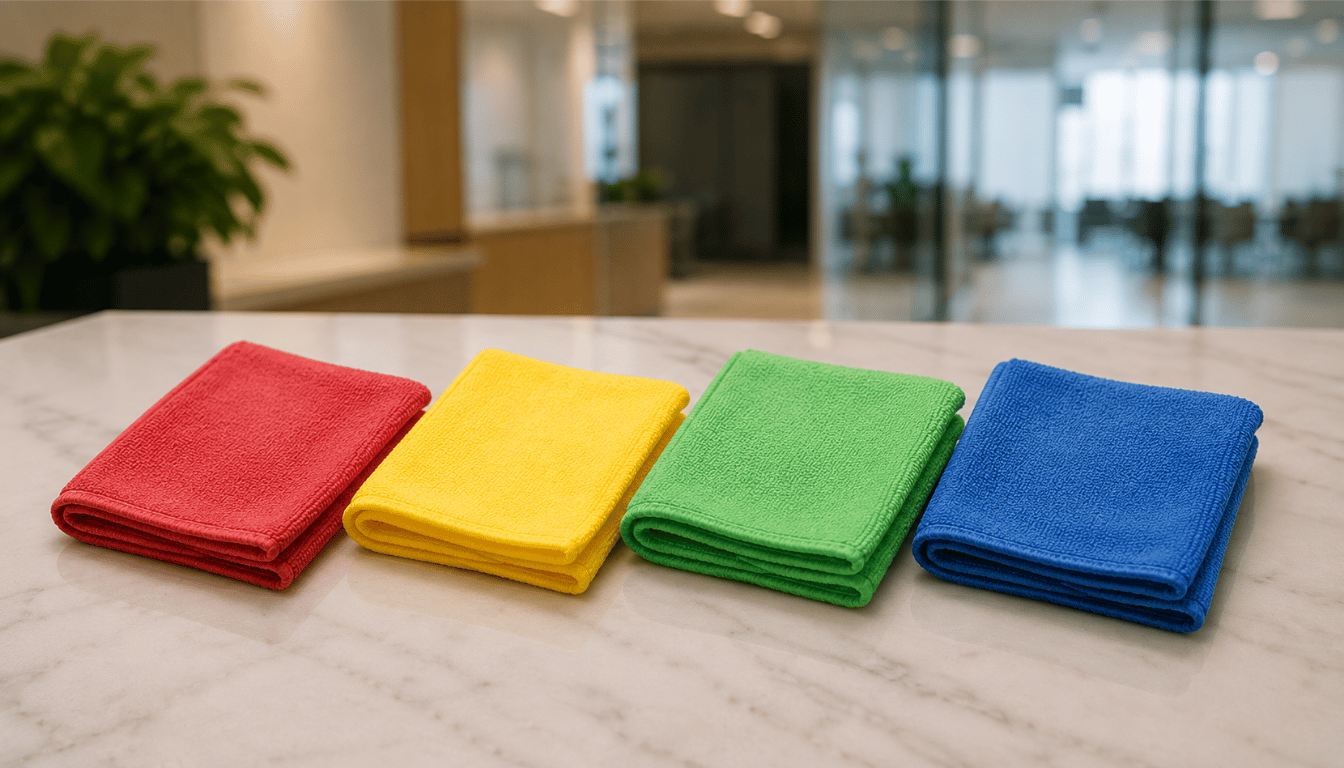
A microfiber color-coding system is a standard commercial cleaning method that separates cloths and tools by color according to work zone, so a cloth used in a restroom is never used in a kitchen or on a work desk. This matters because it prevents germs and contaminants from moving from high-risk areas into areas that should stay clean, such as food-contact surfaces or a reception desk. It's a simple visual system, but one that requires discipline to hold up in day-to-day cleaning routines.
1. Why Microfiber Color-Coding Matters for Preventing Cross-Contamination
Cross-contamination happens when germs, bacteria, or dirt move from one surface to another via the same cleaning tool. The most common example is a cloth used to clean a toilet, then reused to wipe a pantry counter without being washed first. This risks transferring microorganisms from a dirty area to one that should be hygienic, such as a surface that comes into contact with food or employees' hands.
A color-coding system is a practical fix for this risk because it doesn't rely purely on staff memory. With a distinct cloth color per zone, misuse becomes easier to spot visually, both by the staff member themselves and by a supervisor doing oversight rounds, without needing a formal inspection checklist for every single pass.
The risk of cross-contamination isn't only about visible dirt or smell. A surface that looks clean can still be a vector for microorganisms if it was wiped with a cloth previously used in a dirty area. That's why food-contact areas like kitchens and pantries need cloths separate from sanitation areas like restrooms, even though both may "look" clean after wiping — the risk sits at a level a quick visual check simply won't catch.
2. The Four Standard Colors and Their Zones
One color-coding convention commonly used in commercial cleaning divides microfiber cloths into the following four colors. This breakdown can be adapted to a specific building's needs, but the underlying principle stays the same — separating high-risk zones from clean zones.
- Red — high-risk areas. Used specifically for toilets, urinals, and other sanitation surfaces carrying the highest contamination risk. Red cloths should never be used outside this zone under any circumstance, even for a quick wipe-down elsewhere.
- Yellow — washbasins and restroom glass surfaces. Used for sinks, mirrors, and soap dispensers within restrooms, kept separate from red cloths to avoid cross-contact with primary sanitation surfaces.
- Green — kitchen and pantry areas. Used for kitchen counters, refrigerators, and any surface that comes into contact with food, since this area needs a hygiene standard equivalent to food-contact zones in a commercial kitchen.
- Blue — general and office areas. Used for desks, meeting rooms, reception, and general office areas that carry relatively lower contamination risk than restrooms or kitchens, though they still benefit from a dedicated cloth to avoid unnecessary cross-use.
Why This System Works When Applied Consistently
Color-coding only delivers its full benefit when applied across the board, not just to wiping cloths. Cleaning trolleys, buckets, and even gloves should ideally follow the same color scheme, so every piece of equipment in a zone is consistently one color. Cloths of different colors should also be laundered separately to prevent re-contamination during the wash cycle.
Supporting Practice: Storage and Laundering by Color
Beyond field use, a color-coding system needs consistent storage and laundering practices to back it up. Cloths of each color should be stored in separate bins or bags after use, rather than mixed in one bucket or laundry bag. Washing should ideally be separated by color too, or at minimum split between high-risk zone cloths (red, yellow) and clean zone cloths (green, blue), to avoid re-contamination during laundering.
Labeling trolleys and storage areas also helps new staff pick up the system quickly without memorizing the entire written SOP, and lets a supervisor run a visual audit at any time without pulling up the SOP document manually.
3. How TUM Clean Applies This Protocol in Bogor
Field Implementation and Staff Training
TUM Clean, operated under the legal entity PT. Tunggal Utama Makmur and based in Sentul, Kecamatan Babakan Madang, Kabupaten Bogor, applies microfiber color-coding as part of its standard SOP across all commercial assignments in Bogor, Sentul, Ciawi, Cibinong, Cibubur, and Depok. Every new staff member goes through brief training on zone mapping before being assigned to a client site, and on-site supervisors run periodic checks to make sure cloths aren't crossing zones.
For clients with specific needs, such as senior living facilities or areas requiring stricter hygiene standards, zone mapping can be extended beyond the four standard colors — for instance, a separate zone for medical rooms or isolation areas. Supervisors also keep a simple log of which trolleys and cloth sets are assigned to which zone, so a replacement staff member can pick up the routine without a lengthy re-briefing.
Common Mistakes in Color-Coding Implementation
Some frequent mistakes found in buildings that apply color-coding without consistent oversight include:
- Cloths mixed during washing, causing colors to fade or even get swapped after a few laundry cycles, making the system hard to distinguish visually.
- New staff not given a detailed explanation of each color's zone, so they simply copy other staff's habits, which aren't always correct.
- No periodic visual audit by a supervisor, so cross-zone misuse only comes to light after a complaint.
- Trolleys and buckets not following the same color scheme as the cloths, making the system inconsistent across a staff member's full workflow.
4. When to Use a Professional Provider to Implement This System
Implementing color-coding in-house is possible, but it requires a level of training consistency and oversight that isn't always available to small internal cleaning teams. Companies should consider a professional provider when:
- The building has many zones with different contamination risk levels, such as a mix of office, kitchen, and healthcare areas.
- The company needs to demonstrate sanitation compliance during a vendor audit, building certification, or a corporate client visit.
- There isn't the internal time or capacity to train and continuously audit cleaning staff.
- There's been a past complaint related to cleanliness in a food-contact or sanitation area suggesting potential cross-contamination.
- The company wants a cleaning system that can be explained simply to an external auditor or corporate guest visiting the facility, without needing to walk them through a lengthy written SOP.
To learn more about how TUM Clean applies microfiber color-coding at your building, please Contact Us, or read Articles on sanitation standards and compliance.
FAQ
Quick and Practical Consultation
Address
Darmawan Park, Jl. Babakan Madang No.99, Sentul, Kec. Babakan Madang, Kabupaten Bogor, Jawa Barat 16810
Google Maps