Office Cleaning SOP & Checklist Guide to Boost Productivity
A practical guide to build an office cleaning SOP and checklist that reduces disruptions and increase productivity.
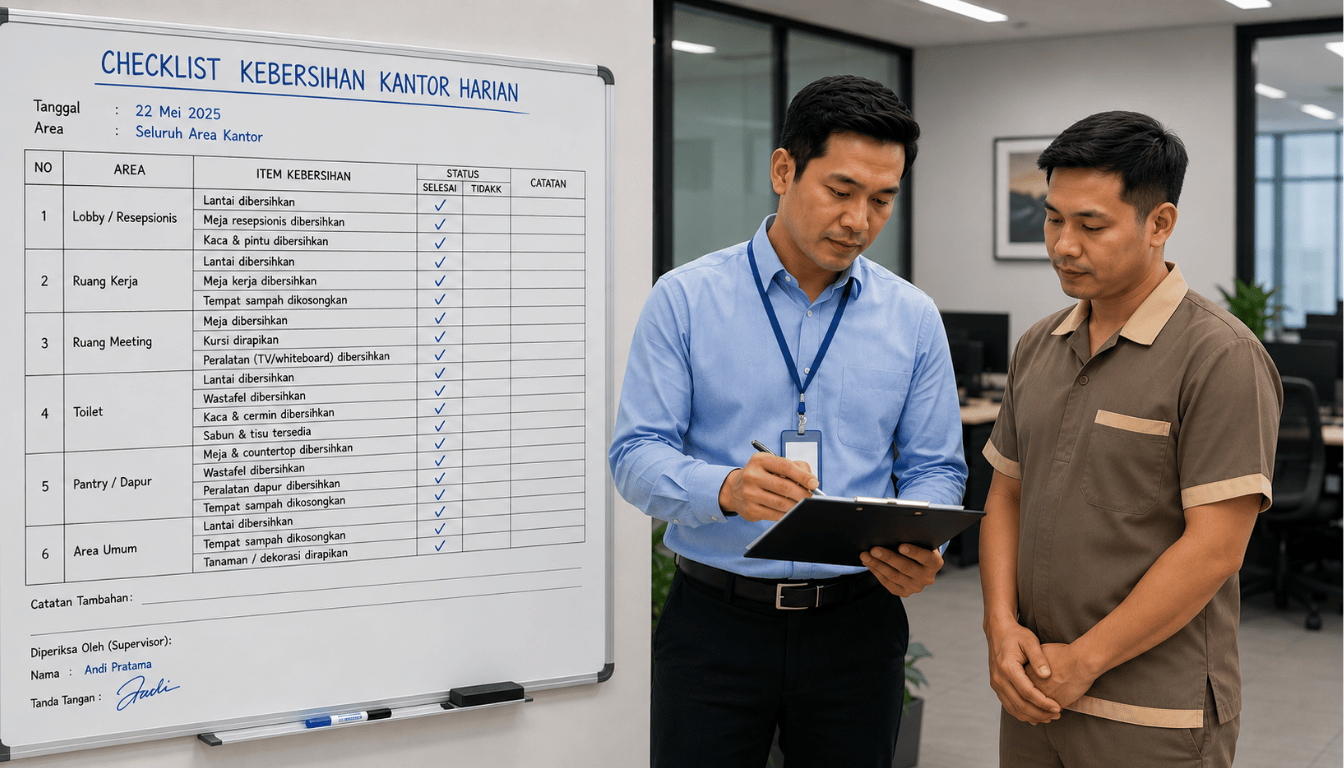
A structured office cleaning SOP and checklist helps improve employee productivity by reducing distractions from an untidy work environment, lowering the risk of illness linked to poor hygiene, and ensuring every area is cleaned consistently rather than depending on a staff member's memory. Without a written SOP, office cleanliness tends to be inconsistent and hard for a facility manager to evaluate.
1. Why an Office Cleaning SOP Matters for Employee Productivity
An untidy or poorly maintained workplace can be a real source of distraction — dusty desks, unhygienic restrooms, or a damp pantry area. Beyond comfort, poor office cleanliness is also linked to germ spread on frequently shared surfaces such as door handles, shared keyboards, and elevator buttons.
A Standard Operating Procedure (SOP) clarifies what needs to be cleaned, how often, and by whom. Without this document, cleaning quality depends heavily on individual staff initiative, making results unpredictable and difficult for building management or HR to evaluate objectively.
Core Components of an Office Cleaning SOP
A solid office cleaning SOP generally includes five components:
- Area and risk-zone mapping — dividing the office into zones such as general work areas, restrooms, the pantry/kitchen, meeting rooms, and reception, since each zone carries different standards and frequencies.
- Cleaning frequency — defining what gets cleaned daily (desks, restrooms, high-traffic flooring), weekly (glass, light AC filter checks, carpet spot cleaning), and monthly (carpet deep cleaning, upholstery, ventilation).
- Technical standards and materials — the chemicals used per zone, color-coded microfiber to prevent cross-contamination, and staff personal protective equipment.
- Ownership and supervision — the person or role responsible for each area, plus a reporting mechanism for missed spots.
- Documentation and verification — a checklist sheet signed or initialed after each cleaning session as proof of SOP compliance.
2. Building Daily, Weekly, and Monthly Checklists
A checklist is the practical, field-level extension of an SOP. Here is a common breakdown that can be adapted to your office layout:
Daily Checklist
- Clean and disinfect shared desks and frequently touched surfaces (door handles, elevator buttons, water dispensers).
- Sweep and mop high-traffic areas such as the lobby, corridors, and pantry.
- Clean and restock restroom supplies (soap, tissue, disinfectant).
- Empty trash bins and replace liners across all work areas.
Weekly Checklist
- Clean windows and glass partitions in meeting rooms.
- Spot-clean carpets in high-traffic zones.
- Wipe down wood or laminate furniture surfaces with appropriate materials.
- Inspect and clean light AC filters on easily accessible units.
Monthly Checklist
- Deep-clean carpets using extraction machines across full work areas.
- Clean upholstery on office chairs and waiting-area sofas.
- Thoroughly clean air ventilation and hard-to-reach spots (shelf gaps, behind furniture).
- Hold a joint review between the facility manager and cleaning team on the month's checklist compliance.
Checklists should be structured for easy verification — for example, columns for date, area, and staff initials — so a facility manager can run spot audits without having to monitor every cleaning session in person.
3. Putting It Into Practice: TUM Clean's Approach and Common Mistakes
How TUM Clean Applies This Model in Bogor
TUM Clean, operated under the legal entity PT. Tunggal Utama Makmur and based in Sentul, Kecamatan Babakan Madang, Kabupaten Bogor, builds office cleaning SOPs and checklists tailored to each client's layout and operating hours across Bogor, Sentul, Ciawi, Cibinong, Cibubur, and Depok. Every engagement includes risk-zone mapping, setting the daily general cleaning frequency, and a periodic deep-cleaning schedule.
TUM Clean's on-site supervisors verify checklists routinely and report compliance back to the client's facility manager, so cleaning quality stays measurable and doesn't depend on a single staff member.
Common Mistakes When Implementing an Office Cleaning SOP
In practice, many offices already have a written SOP on file yet still experience recurring cleanliness issues. Common mistakes seen in the field include:
- An SOP written but never communicated — the document sits in an HR folder without ever being explained directly to the cleaning staff who work the floor every day.
- Checklists signed off without real verification — initials are added as a formality with no spot-checking by a supervisor, so the checklist loses its control function.
- No rotation of responsibility for rarely-seen areas, such as behind furniture or ventilation, so those spots get consistently skipped session after session.
- The SOP never gets updated when the office layout changes — after a renovation or a new workspace addition, for example — leaving new zones outside routine cleaning coverage.
As an illustration, offices of similar size that pair an SOP with routine supervisor audits generally show more stable cleanliness consistency over time than offices relying on checklists alone with no periodic verification. This difference typically only becomes clear after the SOP has been running for a few months, once the team's working habits have settled in.
Checklist for Evaluating SOP Effectiveness
Once the SOP and checklist are running, facility managers should periodically evaluate effectiveness using questions such as:
- Is the daily checklist always filled in and initialed, with no suspicious blank entries?
- Have employee complaints about cleanliness decreased compared to before the SOP was introduced?
- Do high-risk areas (restrooms, pantry) stay clean even under a surprise audit?
- Is compliance documentation available and easy to pull for internal reporting?
4. When to Bring In a Professional Cleaning Provider
Building and running an SOP in-house can be a real challenge, especially for internal teams without a commercial cleaning background. Companies should consider bringing in a professional provider when:
- The office has many zones with different needs (open work areas, server rooms, pantry, restrooms) that are hard to standardize internally.
- No internal staff member has the time or expertise to write, train on, and continuously audit an SOP.
- The company needs cleanliness compliance documentation for client audits, building certification, or investor visits.
- Employees keep raising cleanliness complaints even though cleaning staff are already on-site.
To get help building an office cleaning SOP and checklist tailored to your building's layout, please Contact Us for a consultation, or read href="Articles on facility management.
FAQ
Quick and Practical Consultation
Address
Darmawan Park, Jl. Babakan Madang No.99, Sentul, Kec. Babakan Madang, Kabupaten Bogor, Jawa Barat 16810
Google Maps