Why Regular Office Carpet Cleaning Extends Asset Life
Regular office carpet cleaning prevents fiber damage and extends the life of your carpet asset.
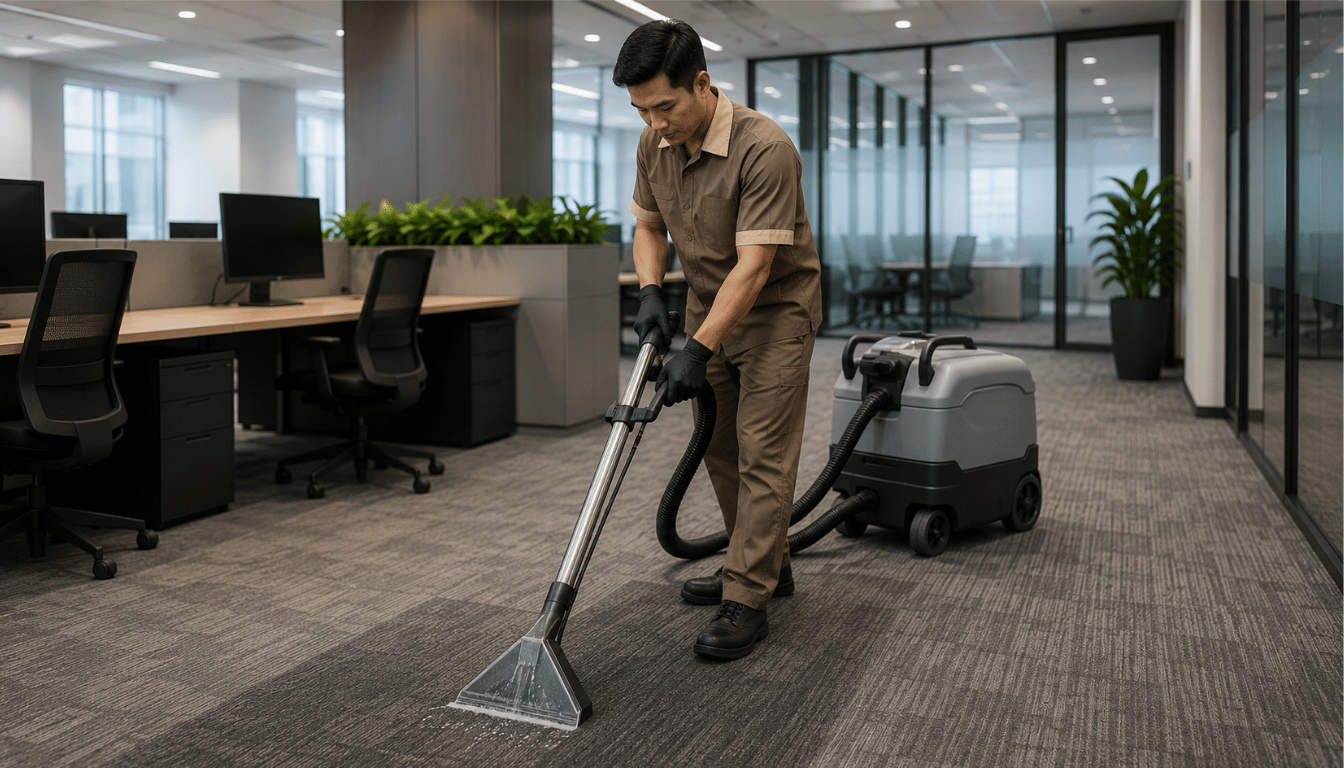
Regular office carpet cleaning extends the life of a company's asset because it prevents dust, grit, and dirt from gradually breaking down carpet fibers from within, while also preventing stubborn stains and odors that force early replacement well before a carpet's intended lifespan. Regular maintenance is far cheaper than the cost of a full carpet replacement, and for many commercial buildings it's one of the easiest asset-maintenance decisions to justify on return alone.
1. Why Office Carpets Wear Out Faster Without Regular Maintenance
Carpet in a work environment faces different pressure than carpet in a home, due to much higher foot traffic — employees, visitors, and couriers passing through every day track in dust, fine grit, and outdoor particles. These particles work their way into the carpet fibers, and if not fully removed, act like a micro-abrasive that grinds down the fibers every time the carpet is stepped on [Insert reference to manufacturer/industry association carpet-lifespan specifications].
Daily vacuuming only lifts surface-level dirt, while particles that have already worked their way into the lower fiber layer need a pressure-and-heat extraction process to be truly removed. Without that process, fiber damage builds up gradually and often only becomes visible once the carpet starts looking dull or matted in high-traffic areas like corridors and entrances — by which point some of that wear is effectively permanent.
Beyond the physical wear on fibers, a carpet that rarely gets deep-cleaned also becomes a reservoir for allergens and fine particles that can affect indoor air quality, particularly in buildings with closed ventilation systems. For offices where employees spend long hours in air-conditioned rooms, this can add to comfort-related complaints about air quality in the work area, which HR teams sometimes struggle to trace back to the carpet itself.
2. How a Neglected Carpet Affects a Company's Asset Costs
Office carpet represents a meaningful investment, especially for buildings with large work areas. When a carpet wears out ahead of schedule, a company faces two avoidable additional costs:
- Early replacement cost — replacing carpet before its intended lifespan ends means the company never realizes the full value of its original purchase, effectively paying twice for the same square footage of flooring.
- Operational disruption cost — a large-scale carpet replacement usually requires temporarily clearing the work area, which can disrupt productivity for the team based there, sometimes for several days depending on the area's size.
- Impact on the building's visual impression — dull or stained carpet in a reception area or meeting room can affect a visitor's or client's first impression of the company's professionalism, regardless of how well-maintained the rest of the office is.
When a Carpet Needs Deep Cleaning
As a general guide, high-traffic areas like lobbies and corridors typically need deep cleaning more often than a rarely-used meeting room. Signs a carpet needs deep cleaning soon include stains that don't lift with regular vacuuming, a lingering damp smell, or a visible color shift in one area compared to the surrounding carpet.
3. How TUM Clean Deep-Cleans Carpets in Bogor
Method and Equipment
TUM Clean, operated under the legal entity PT. Tunggal Utama Makmur and based in Sentul, Kecamatan Babakan Madang, Kabupaten Bogor, uses extraction machines for commercial carpet deep cleaning across Bogor, Sentul, Ciawi, Cibinong, Cibubur, and Depok. The method works by spraying a pressurized cleaning solution into the carpet fibers, then extracting that solution along with the lifted dirt using the machine's suction, so minimal moisture is left behind and the carpet can be back in use sooner.
Deep-cleaning schedules are matched to each client area's traffic volume rather than applying one uniform schedule building-wide, so a reception area or main corridor can be serviced more often than a storage room or a rarely-used work area. This targeted scheduling also keeps costs proportional to actual wear rather than treating every square meter of carpet identically.
Common Steps in a Carpet Deep-Cleaning Process
A commercial carpet deep clean generally follows several stages to get the best result without rushing the fibers into damage:
- Thorough pre-vacuuming to lift dry dust and particles from the surface before the wet process starts, so the cleaning solution isn't just binding surface dirt into mud.
- Pre-treatment on stained areas using a solution matched to the stain type, left to sit briefly before the main extraction pass.
- The extraction process, using a pressurized machine to spray and immediately extract the cleaning solution along with dirt lifted from within the fibers.
- Drying, using ventilation or fans to bring the area back to usable dryness, typically within a few hours depending on room humidity.
Common Mistakes in Office Carpet Care
Some frequent mistakes that cause a carpet to wear out faster than it should include:
- Relying only on daily vacuuming with no periodic deep cleaning, so dirt that's already worked into the lower fiber layer never gets truly removed.
- Letting stains sit too long before treatment, allowing them to soak in deeper and become harder to remove without damaging fiber color.
- Using chemicals not matched to the carpet type, which risks damaging the fiber's protective coating or leaving a residue that actually speeds up future dirt buildup.
- No written maintenance schedule, so deep cleaning only happens reactively once the carpet looks very dirty, rather than as preventive maintenance.
4. Building the Right Carpet Maintenance Schedule for Your Office
An ideal carpet maintenance schedule generally factors in several elements below, rather than applying one identical schedule across every area:
- Daily traffic volume in each area — the higher the traffic, the more often deep cleaning is needed.
- Fiber and carpet material type, since some materials are more prone to staining or dust buildup than others.
- Exposure to external dirt sources, such as proximity to a main entrance or parking area.
- A history of odor or stain complaints in a specific area, which signals a need for more frequent care.
As a general illustration, very high-traffic areas like a main lobby may need deep cleaning every few months, while a rarely-used meeting room might only need it twice a year. Exact figures still need to be matched to each building's actual conditions [Insert specific frequency recommendation based on a site survey], since traffic patterns can vary significantly even between floors of the same building.
To get a deep-cleaning schedule recommendation tailored to your building's layout and traffic volume, please Contact Us, or read Articles on specialist and project cleaning.
FAQ
Quick and Practical Consultation
Address
Darmawan Park, Jl. Babakan Madang No.99, Sentul, Kec. Babakan Madang, Kabupaten Bogor, Jawa Barat 16810
Google Maps